This poem is music to our ears. Credit goes to redditor /u/RamsesThePigeon.
It's with an apostrophe simply means "it is."
Its denotes possession, much like "hers" or "his."
Everyday means commonplace, mundane, or benign.
Every day just indicates consistent points in time.
Your implies that something belongs solely to "you."
You're is short for "you are," which you already knew.
Whose is for possession; ownership again.
Who's gets used for "who is," like "Hey there! Who's your friend?"
There is a location, they're means "they are."
Their means it belongs to them. (It's the most misused by far.)
Two is just a number, too can mean "as well."
To is a preposition, like "Damn it, go to hell!"
Passed refers to passing, it's something that you did.
Past involves direction, time, or a period.
Than implies comparison, brought to mind forthwith.
Then is for progression, or the partner to "if."
If ever something fazes you, it might make you swoon.
Phases reference different states, like those of the moon.
Loose implies that something is neither firm nor tight.
Lose is what you do when you get into a fight.
Advice is something that you give when you try to advise.
Alot is simply not a word. Claims that it is are lies.
Affect is a potent verb and effect is a noun.
(True, there are exceptions, but those do not abound.)
Now you know the proper use, your excuses are gone.
If you still misuse homophones, then you are a moron.
Tuesday, October 28, 2014

Thursday, April 24, 2014
A Few Pointers on Point of View, Part 2: Viewpoint
Part 1 of A Few Pointers discussed the broad subject of Point of View (POV). For every story there's someone holding the camera through which we view the action. Whatever that specific camera captures of the action and characters is all that readers get to know about the story. But there is a deeper viewing level in POV narrating with subtle yet significant influence called viewpoint.
To be honest, it may be the camera/movie analogy that causes authors confusion with viewpoint when they write in any tense or POV, because the action in movies usually moves effortlessly from face to face and scene to scene, capturing emotions that aren’t necessarily viewed by the narrating character but must be viewed by the audience for significance in the storyline. When we use words to put all of that emotion and action on a page, we have tighter rules regarding flow to keep our story seamless for our readers. The POV narrator will choose characters to drive readers through each scene. This character becomes the viewpoint for the action as it plays out in relation to that character, his or her thoughts, feelings, observations, etc.
In a book, if the narrator chooses Darla to carry the scene, as her attention is captivated by one suitor, the narrator draws our attention to the action as it relates to Darla. We'll know what's making her blush, we can get insights from her observations, but we won't be able to know what the other suitor is thinking or feeling so long as she's not observing him.

If Darla is our viewpoint character, we will read the scene as it affects her; the scene will move as though bending and revolving around her. What her eyes observe in the dining hall will be what the narrator can offer comment on. The suitor she interacts with will be the focus of the narrator; the narrator will ignore the jealous suitor until Darla gives him notice. If the narrator enters the scene with Darla's viewpoint, to keep readers in the flow, the POV must stay fixed on Darla's presence and interactions.
Here's what an unwarranted viewpoint shift would read like if we started in Darla's viewpoint and suddenly entered Alfalfa's:
One last example of viewpoint: Think of the Sherlock Holmes movie, A Game of Shadows. We mostly follow the action as described and put in motion by Sherlock, and every now and again we enter his mind to preview how he’s about to take down his opponent. He narrates a play-by-play of each blow the opponent will receive at his hand. That action unfolds from Sherlock’s viewpoint.
Well, in the ending struggle scene between Moriarty and Sherlock, we watch how the action will play out first according to Sherlock, but then Moriarty says in his mind, “Come now, you really think you’re the only one who can play this game?” Moriarty interrupts the Sherlock viewpoint, and where normally that could be a faux pas, it works because of the directing style and character development of the film.
When in Moriarty’s mind he succeeds in pushing Sherlock over the ledge, he raises his arms victorious. We get to partake of his emotion; we are suspended in his viewpoint. Then we shift back to the “present” moment before any of the envisioned fighting happens, back into the Sherlock viewpoint.
See how effortlessly the camera gets to move through viewpoints? We don’t even realize it as we watch movies unless we’re looking for it. And while movies can get away with this, books can’t. We’re so used to seeing it happen and some authors mistakenly mimic movies and try to pinball between viewpoints to cover everyone’s emotions in each scene. The problem is, we read differently than we watch. In film, we can only interpret by what we’re allowed to see, so movies have to show it all. There’s no expository paragraph that explains how Watson is feeling in the film; we watch his eyes stare in shock and slowly close in disbelief.
To take a peek at the differences between written and visual POV, I wrote out what that scene from the movie might read like as a scene in a book. We'll start right after Moriarty believes he will come out victor of the pretend fight scenario.

1. Choose your story’s overall point of view according to the most important information that you’ll need to share.
If you’re going to need to include several scenes from the past or happening simultaneously to the main character’s storyline, don’t choose 1st person. If you need help finding out which POV might be best for your story, pick an important scene that involves multiple character and write it in each POV. You may discover you prefer one presentation of the scene over the others.
2. Choose your viewpoint character per scene and stick to it.
Whichever character will be introducing us to the scene and directing the “camera” around to capture the action they observe, remember to keep their lens as the only one you narrate and describe the action through.
3. Execute changes in viewpoint at clear and natural scene, chapter, or section breaks.
If you have questions or any other tips that helped you practice POV and viewpoint, leave a comment!
To be honest, it may be the camera/movie analogy that causes authors confusion with viewpoint when they write in any tense or POV, because the action in movies usually moves effortlessly from face to face and scene to scene, capturing emotions that aren’t necessarily viewed by the narrating character but must be viewed by the audience for significance in the storyline. When we use words to put all of that emotion and action on a page, we have tighter rules regarding flow to keep our story seamless for our readers. The POV narrator will choose characters to drive readers through each scene. This character becomes the viewpoint for the action as it plays out in relation to that character, his or her thoughts, feelings, observations, etc.
In a book, if the narrator chooses Darla to carry the scene, as her attention is captivated by one suitor, the narrator draws our attention to the action as it relates to Darla. We'll know what's making her blush, we can get insights from her observations, but we won't be able to know what the other suitor is thinking or feeling so long as she's not observing him.

If Darla is our viewpoint character, we will read the scene as it affects her; the scene will move as though bending and revolving around her. What her eyes observe in the dining hall will be what the narrator can offer comment on. The suitor she interacts with will be the focus of the narrator; the narrator will ignore the jealous suitor until Darla gives him notice. If the narrator enters the scene with Darla's viewpoint, to keep readers in the flow, the POV must stay fixed on Darla's presence and interactions.
Here's what an unwarranted viewpoint shift would read like if we started in Darla's viewpoint and suddenly entered Alfalfa's:
When she heard Waldo's voice, Darla turned from speaking with Alfalfa to greet him. She found it rude that he so obviously interrupted their dinner, but politely extended her hand as he bowed stiffly from the waist. Alfalfa couldn't believe Waldo would intrude on such a special moment.The bolded phrases in that paragraph demonstrate how we enter two different sources of feeling/reaction during one scene. The reactive, observational, or internal feeling of the action should only be narrated through one character at a time, the character chosen as the viewpoint lens. Below is another example of what not to do.
Harry couldn’t believe what Ron had just said to him. He wanted to ring Ron’s stupid neck, but stupid Hermione stood between them with arms outstretched, keeping the boys apart. Ron looked back at Harry with smug satisfaction knowing his words had cut Harry deeply. Hermione loudly sighed with exasperation, impatient that her two friends would be such dolts over nothing.Here, in one brief scene, we entered three different minds. Don’t do that. If you don’t see a problem with the flow in these paragraphs, your homework is to study up on POV and viewpoint.
One last example of viewpoint: Think of the Sherlock Holmes movie, A Game of Shadows. We mostly follow the action as described and put in motion by Sherlock, and every now and again we enter his mind to preview how he’s about to take down his opponent. He narrates a play-by-play of each blow the opponent will receive at his hand. That action unfolds from Sherlock’s viewpoint.
Well, in the ending struggle scene between Moriarty and Sherlock, we watch how the action will play out first according to Sherlock, but then Moriarty says in his mind, “Come now, you really think you’re the only one who can play this game?” Moriarty interrupts the Sherlock viewpoint, and where normally that could be a faux pas, it works because of the directing style and character development of the film.
When in Moriarty’s mind he succeeds in pushing Sherlock over the ledge, he raises his arms victorious. We get to partake of his emotion; we are suspended in his viewpoint. Then we shift back to the “present” moment before any of the envisioned fighting happens, back into the Sherlock viewpoint.
See how effortlessly the camera gets to move through viewpoints? We don’t even realize it as we watch movies unless we’re looking for it. And while movies can get away with this, books can’t. We’re so used to seeing it happen and some authors mistakenly mimic movies and try to pinball between viewpoints to cover everyone’s emotions in each scene. The problem is, we read differently than we watch. In film, we can only interpret by what we’re allowed to see, so movies have to show it all. There’s no expository paragraph that explains how Watson is feeling in the film; we watch his eyes stare in shock and slowly close in disbelief.
To take a peek at the differences between written and visual POV, I wrote out what that scene from the movie might read like as a scene in a book. We'll start right after Moriarty believes he will come out victor of the pretend fight scenario.
With pipe smoke pulsing from his mouth, Sherlock Holmes stared his nemesis down, cautious not to let his mind reveal his next move. He cracked a wide, uncertain smile and led his opponent to believe his thoughts surrendered with, “Conclusion inevitable . . .” Moriarty’s face broke with a satisfied sneer. Sherlock shifted his pipe around his teeth. “Unless—”
Whipping the pipe from his mouth, Sherlock blasted a puff of breath at the still-burning lighter in Moriarty’s hand. Tiny sparks flew at the professor’s face and instinctively he turned away. Locking Moriarty’s arms and body into a hold, Sherlock braced himself against the stone banister and kicked his foot up to the chess table to launch the pair of them over the edge.
In the instant before Sherlock pushed off, Watson hurried through the balcony door from inside the mansion. If any word of warning had been prepared on Watson’s lips, it instantly vanished as he took in the scene before him. Sherlock tossed his friend one last familiar smirk, closed his eyes, and pushed backward with all his might.
Sherlock knew that two were falling, but with eyes closed he regained his cherished solitude. He preferred to think of himself as purposefully taking an unconventional shortcut to the bottom of the mountain. He heard only the air rushing past his ears, felt only the stinging kiss of the raging waterfall mist. His opponent released him and they plunged into silence.In writing, it made more sense to follow Sherlock off the cliff and complete the action from his viewpoint before returning to finish the scene from Watson’s viewpoint. In the movie we watch Watson’s reaction for a few seconds before witnessing the two men falling. To do that in writing would cause readers to ping-pong between perspectives and it isn’t natural in the reading setting. But when the scene breaks naturally, switching to Watson to wrap up the emotion and observation is a seamless move in writing.
Watson stood by the door staring at the emptiness where an instant before his friend’s eyes stared back. He slowly blinked, daring not to believe. He stepped toward the banister, absently rounding the chess table with unfinished game. His eyes fixed on the ledge where the soft layer of snow had been abruptly swept away by the fallen. With his body rigid, Watson leaned out of the balcony shadows, his wrinkled brow catching the moonlight. He peered down the torrential falls at the tight canyon walls disappearing below the icy mist. He did not trust to hope even his cunning friend had survived such a drop.
POV Points to Remember
1. Choose your story’s overall point of view according to the most important information that you’ll need to share.
If you’re going to need to include several scenes from the past or happening simultaneously to the main character’s storyline, don’t choose 1st person. If you need help finding out which POV might be best for your story, pick an important scene that involves multiple character and write it in each POV. You may discover you prefer one presentation of the scene over the others.
2. Choose your viewpoint character per scene and stick to it.
Whichever character will be introducing us to the scene and directing the “camera” around to capture the action they observe, remember to keep their lens as the only one you narrate and describe the action through.
3. Execute changes in viewpoint at clear and natural scene, chapter, or section breaks.
If you have questions or any other tips that helped you practice POV and viewpoint, leave a comment!
Monday, April 14, 2014
A Few Pointers on Point of View, Part 1
Our discussion on point of view (POV) will be covered in two parts: Point of View and Viewpoint. Yes, there's a difference! Today we'll take a good, hard look at POV so that the Viewpoint post makes (hopefully) perfect sense.
As writers, we will always be improving our style, craft, and depth of knowledge, but one of the first things we need to get a rope around is point of view.
Beautiful and wild ideas swirl and pace restlessly in our minds, roaring to get onto the page. Writers really aren't any different from circus animal trainers—and even trainers need training before they can authoritatively tame their ideas to enter the blank-page arena with graceful flow.
Here are a few pointers to help you gain Alpha status in the ring where your published words will put on the greatest novel show on earth. It's advice that might literarily save your life as an author.
 Okay, maybe it's not that dramatic—but nothing will tip off an editor to your undeveloped writing ability quicker than an unwarranted shift in your story's POV tense or unwarranted shifts in viewpoint.
Simply put, the POV is set from whoever narrates the story. But for creative flair, we like to think of POV as the camera filming your characters when and wherever they interact. She who holds the camera holds the POV power. We watch the "movie" of your story unfold through observations available from this narrator's “lens” or specified vantage point.
Establishing a solid POV allows your story to be seen through one steady lens and gives your readers stability plus the ability to get sucked into the story's believability. Giving you credibility. Indubitably.
If your story requires it, you can hand off camera duties, but you have to be careful to do it purposefully and, we'd advise, at a natural break in your story (like at a new chapter or scene break). The last thing you want to do is throw your readers out of your story because they don't know whose head they're in anymore. Most people are okay with sticking with a chosen POV and have a trickier time with sticking to the viewpoint, but what we see as editors all too often are writers who start out in past tense and teeter-totter to present tense or even fall off into the tricky pit of past perfect.
First Person. This narrator is also a character in the story, and we know the inner workings of only this character's mind and heart. He or she can only suppose or observe what other characters might be thinking or seem to be feeling. We watch the action unfold as if perched behind the eyes of our narrator only. If the character can't see or hear or sense what's happening, the reader can't either. It limits the writer to choose this POV, but it creates a very powerful connection for readers and the main narrating character.
 For example, Suzanne Collins chose her main character, Katniss Everdeen, to tell the Hunger Games story in first person present tense. This means we only know the story as it unfolds according to Katniss in the very moment things are happening. If she gets knocked out a few dozen times, there will be action we miss out on until she comes to. Strategic dialogue or other means of discovery are the only ways we can catch up on what happened while her "camera lens" was blacked out.
First person can take on past tense as well, and we commonly read books with this POV. This is when the narrator speaks in “I was” and “we went” but might be able to offer greater insight along the way since the action is all being retold from happening in the past. The Adventures of Huckleberry Finn is a good example of this POV.
Another version of first person POV that can be effective in telling some stories is the epistolary novel, where letters between characters lay the story out, both in past and in present tense. Past for describing the action ("He called upon me at my father's house.") and present for the emotion of the scribe ("I am horrified at the thought that he will come again tomorrow."), and this method allows for shifts in tense to be common and understandably sudden.
Second Person. This narrator refers to the reader, and is somewhat uncommon in fiction. You'll hear it a lot in song lyrics, poetry, self-help books, advertising, or awesome editorial blog posts. The narrator nudges you along from one idea, one suggestion, or one scene to the next. For novels, the selected narrator will confide in the reader, share secrets, take the reader on as a buddy or sidekick, and this can be very effective for readers to connect to your story. The author narrator introducing us to the Baudelaire children in A Series of Unfortunate Events immediately catches our attention by using a direct second-person approach.
Think of all the books you read to little kids. "What does the dog say?" the book asks the child. The child is immediately engaged because she is directly addressed to involve herself. The fuzzy monster in the picture is asking the child to follow along for a wild adventure.
Or, an author might use second person to tell someone else's story, someone who can't speak for themselves. This would include a dying father writing to his unborn child, laying out the dream he has for him to grow up, graduate, marry, and be successful in life. Or, a young girl, feeling ambitious, who writes a letter to her older self, outlining the goals she should accomplish by the ripe old age of twenty-two. Second person has a powerful presence when artfully employed.
Third Person. This is the narrating voice above the characters that is separate from the story. This may be the omniscient author himself or a voice he assigns to narrate the happenings of all the characters. And while most authors are extremely used to reading and writing in this POV, this is where the most mistakes are made in viewpoint shifts.
Third person present tense would include, "She steps sleepily toward the snake aquarium as if entranced by the soft glow and hum of the heat lamps. A small noise squeaks from the brown paper bag hanging loosely in her hand."
Third person past tense would read, "He spit on the ground and saw blood. His one rule: as long as he didn't start the fight, he felt perfectly justified offering his skills to finish it."
A moment of past perfect during past tense: "Harold sat on the church steps in his rented tuxedo, retracing every moment of the day in his mind. The morning's festivities had gone off without a hitch. His frowned deepened. Now the afternoon would also go off without a hitch—the one that would have made Bernice his forever."
To use the ringmaster analogy to further demonstrate POV examples, imagine you're a journalist in the stands, watching the dramatic display of courage unfold and tweeting live updates to your Twitter followers. You'll share the action from a withdrawn third-person POV, and you'll likely use past tense: "That lion just about bit off the tamer's arm! #circussnacks" or maybe present tense: "Oh no! A second lion entered the ring. Let's hope he's trained for this. #dinnerfortwo"
Now imagine you receive a colorful advertisement about the circus coming to town. It might include such direct phrases as:
"Are you ready for the MANE event?"
"We aren't LION when we say you don't want to miss this show!"
The author of that material addresses the reader directly in second-person POV.
Finally, imagine if the lion tamer held the whip in one hand and our POV camera in the other: reading the scene as told by the lion tamer would offer a dramatically different experience—or what about the lion himself? These two characters are actually involved in the action and can share a much more intimate account of the scene.
Now, for a fun exercise, take a scene from your own work in progress and try it in a new tense or from a different POV. You may find that you like the life it brings to your story, but in the least, it may just get those writing juices flowing, so give it a try! Our pointers on viewpoint come next!
Tweetable: Need a refresher on point of view? The folks at @CastleEdit have got you covered: http://ctt.ec/7yi8P+ #writetip #amwriting
As writers, we will always be improving our style, craft, and depth of knowledge, but one of the first things we need to get a rope around is point of view.
Beautiful and wild ideas swirl and pace restlessly in our minds, roaring to get onto the page. Writers really aren't any different from circus animal trainers—and even trainers need training before they can authoritatively tame their ideas to enter the blank-page arena with graceful flow.
Here are a few pointers to help you gain Alpha status in the ring where your published words will put on the greatest novel show on earth. It's advice that might literarily save your life as an author.
What Is POV?
Simply put, the POV is set from whoever narrates the story. But for creative flair, we like to think of POV as the camera filming your characters when and wherever they interact. She who holds the camera holds the POV power. We watch the "movie" of your story unfold through observations available from this narrator's “lens” or specified vantage point.
Establishing a solid POV allows your story to be seen through one steady lens and gives your readers stability plus the ability to get sucked into the story's believability. Giving you credibility. Indubitably.
If your story requires it, you can hand off camera duties, but you have to be careful to do it purposefully and, we'd advise, at a natural break in your story (like at a new chapter or scene break). The last thing you want to do is throw your readers out of your story because they don't know whose head they're in anymore. Most people are okay with sticking with a chosen POV and have a trickier time with sticking to the viewpoint, but what we see as editors all too often are writers who start out in past tense and teeter-totter to present tense or even fall off into the tricky pit of past perfect.
Some POV Examples
First Person. This narrator is also a character in the story, and we know the inner workings of only this character's mind and heart. He or she can only suppose or observe what other characters might be thinking or seem to be feeling. We watch the action unfold as if perched behind the eyes of our narrator only. If the character can't see or hear or sense what's happening, the reader can't either. It limits the writer to choose this POV, but it creates a very powerful connection for readers and the main narrating character.
First person can take on past tense as well, and we commonly read books with this POV. This is when the narrator speaks in “I was” and “we went” but might be able to offer greater insight along the way since the action is all being retold from happening in the past. The Adventures of Huckleberry Finn is a good example of this POV.
Another version of first person POV that can be effective in telling some stories is the epistolary novel, where letters between characters lay the story out, both in past and in present tense. Past for describing the action ("He called upon me at my father's house.") and present for the emotion of the scribe ("I am horrified at the thought that he will come again tomorrow."), and this method allows for shifts in tense to be common and understandably sudden.
Second Person. This narrator refers to the reader, and is somewhat uncommon in fiction. You'll hear it a lot in song lyrics, poetry, self-help books, advertising, or awesome editorial blog posts. The narrator nudges you along from one idea, one suggestion, or one scene to the next. For novels, the selected narrator will confide in the reader, share secrets, take the reader on as a buddy or sidekick, and this can be very effective for readers to connect to your story. The author narrator introducing us to the Baudelaire children in A Series of Unfortunate Events immediately catches our attention by using a direct second-person approach.
 |
| “If you are interested in stories with happy endings, you would be better off reading some other book.” |
Or, an author might use second person to tell someone else's story, someone who can't speak for themselves. This would include a dying father writing to his unborn child, laying out the dream he has for him to grow up, graduate, marry, and be successful in life. Or, a young girl, feeling ambitious, who writes a letter to her older self, outlining the goals she should accomplish by the ripe old age of twenty-two. Second person has a powerful presence when artfully employed.
Third Person. This is the narrating voice above the characters that is separate from the story. This may be the omniscient author himself or a voice he assigns to narrate the happenings of all the characters. And while most authors are extremely used to reading and writing in this POV, this is where the most mistakes are made in viewpoint shifts.
 |
| photo credit. |
Third person past tense would read, "He spit on the ground and saw blood. His one rule: as long as he didn't start the fight, he felt perfectly justified offering his skills to finish it."
A moment of past perfect during past tense: "Harold sat on the church steps in his rented tuxedo, retracing every moment of the day in his mind. The morning's festivities had gone off without a hitch. His frowned deepened. Now the afternoon would also go off without a hitch—the one that would have made Bernice his forever."
Summary
To use the ringmaster analogy to further demonstrate POV examples, imagine you're a journalist in the stands, watching the dramatic display of courage unfold and tweeting live updates to your Twitter followers. You'll share the action from a withdrawn third-person POV, and you'll likely use past tense: "That lion just about bit off the tamer's arm! #circussnacks" or maybe present tense: "Oh no! A second lion entered the ring. Let's hope he's trained for this. #dinnerfortwo"
Now imagine you receive a colorful advertisement about the circus coming to town. It might include such direct phrases as:
"Are you ready for the MANE event?"
"We aren't LION when we say you don't want to miss this show!"
The author of that material addresses the reader directly in second-person POV.
Finally, imagine if the lion tamer held the whip in one hand and our POV camera in the other: reading the scene as told by the lion tamer would offer a dramatically different experience—or what about the lion himself? These two characters are actually involved in the action and can share a much more intimate account of the scene.
.png) |
| Photo credit. |
Tweetable: Need a refresher on point of view? The folks at @CastleEdit have got you covered: http://ctt.ec/7yi8P+ #writetip #amwriting
Wednesday, March 5, 2014
Semicolons and Colons
Recently we asked some folks what the most confusing grammar rule is. We got a lot of who vs. whom, affect vs. effect, and semicolon confusion. We've already cleared up who and whom, so let's get down to business on another issue: the semicolon.

More examples:
Here's a pretty straightforward list: "I need new shoes, a belt, and gloves." Three distinct items, all separated by commas. Not too bad.
Here's a more confusing list: "His excuses were myriad: His shoes, belt, and gloves went missing; his cat—who had a terrible case of diarrhea—needed to be picked up from the vet; and his mother, father, and siblings had given away all his possessions."
So, in the above example, the poor guy had three excuses. We used semicolons to separate them because in a couple of his excuses there were commas and em dashes.

As always, please comment below if you have any questions or need further examples. And if you have a project that needs polishing, just head to the Interest Form and let us know. We're always happy to help.
*This example is taken from the 16th edition of the Chicago Manual of Style.
Semicolons
Separating Independent Clauses
In our last post, we explained what clauses are and how to use them. Understanding that concept will be very useful when we're talking about semicolons. Strictly speaking, semicolons are mainly used to separate independent clauses when you still want them somewhat connected. Let's look at an example.- She spent much of her free time immersed in the ocean; no mere water-resistant watch would do.*

More examples:
- Call me later; I have something to tell you.
- If you want to see John, you'll have to wait; he's away on vacation.
- Your comments are unnecessary; I know my shirt is ugly.
- The trumpet player developed a painful cold sore; therefore plans for a third show were scrapped.*
- I wish I could tell you I finished the project; unfortunately, the flu prevented me from working on it.
Semicolons in Complex Lists
We've talked about using commas in lists before, but what you might not know is that semicolons are also dead useful when your list has internal punctuation. What the heck does that mean, you ask? Let's discuss.Here's a pretty straightforward list: "I need new shoes, a belt, and gloves." Three distinct items, all separated by commas. Not too bad.
Here's a more confusing list: "His excuses were myriad: His shoes, belt, and gloves went missing; his cat—who had a terrible case of diarrhea—needed to be picked up from the vet; and his mother, father, and siblings had given away all his possessions."
So, in the above example, the poor guy had three excuses. We used semicolons to separate them because in a couple of his excuses there were commas and em dashes.

Colons
Colons are also used to separate clauses, but they're a little bit more versatile: They can separate independent and dependent clauses or they can separate two independent clauses (like we did here in this very sentence!). Generally, though, colons are considered stronger than semicolons and should be used when you're indicating that what follows the colon explains or amplifies what came before it. For example, they're frequently used to introduce lists.- Things to pack: shampoo and conditioner, a razor, and a towel.
- I just had a great idea: Let's get a puppy!
- Yolanda faced a conundrum: She could finish the soup, pretending not to care that what she had thought until a moment ago was a vegetable broth was in fact made from chicken. She could feign satiety and thank the host for a good meal. Or she could use this opportunity to assert her preference for a vegan diet.*
 | |
| We were going to do an image search for "colon," but we thought better of it. |
As always, please comment below if you have any questions or need further examples. And if you have a project that needs polishing, just head to the Interest Form and let us know. We're always happy to help.
*This example is taken from the 16th edition of the Chicago Manual of Style.
Thursday, January 2, 2014
Commas, the Trickiest Punctuation Mark Ever, Part Two—Clauses and More
Last time, we discussed the Oxford comma, appositives, and parentheticals. This week, we're continuing our work on the comma with pointers on how it works with clauses and how to use it in a quotation or in dialogue.
"When her mother gave her permission, Maria decided it was time to run away."
There are two clauses here: "When her mother gave her permission," and "Maria decided it was time to run away." We could even condense these into "Mother gave" and "Maria decided." That's all it takes to have a clause.
Now, as it happens, one of the clauses is an independent clause and one is a dependent clause. Which one is which, and why? Let's find out.
Commas are also used between independent clauses, like in the sentence "Do you want to get Indian food, or should we order a pizza?" Notice that there is also a conjunction (that's the "or") and that the comma comes before it. This is a wobbly sort of rule, however. Many styles say that the comma can be omitted if the second independent clause is very short.
If there are two independent clauses with the same subject, you don't need a comma. For example, "Beth and Stan danced and sang." This looks a little tricky because the subject is implied with "sang." It would be weird to say "Beth and Stan danced and Beth and Stan sang," right? But even when we take them out, they're still performing the action, so it's still technically a clause.

Well, hasn't this been fun? I hope this pair of posts has made things a little clearer. Once you understand the structure of your sentence, it's a lot easier to figure out where the commas go. (Did you notice I had a dependent/independent clause combo there?) There are a few other miscellaneous comma uses that we didn't get to. If you have any questions about them, about this post, or about our polishing service, please comment below or email us.
Commas in clauses
What's a clause?
Clauses are the smallest unit of a sentence that communicates a complete thought. A clause requires nothing more than a noun and a verb."When her mother gave her permission, Maria decided it was time to run away."
There are two clauses here: "When her mother gave her permission," and "Maria decided it was time to run away." We could even condense these into "Mother gave" and "Maria decided." That's all it takes to have a clause.
Now, as it happens, one of the clauses is an independent clause and one is a dependent clause. Which one is which, and why? Let's find out.
Independent clauses
Independent clauses are clauses that don't need the other part of the sentence to make sense. Which clause in our previous sentence is the independent clause? "When her mother gave her permission" doesn't make sense on its own, but "Maria decided it was time to run away" makes perfect sense. It doesn't need the first part to get its message across. |
| Which one is dependent and which is independent? Image credit: http://www.schoolatoz.nsw.edu.au/ |
Dependent clauses
As you might have guessed, dependent clauses do need their independent counterparts. They depend on them to give them meaning. That would be the "mother's permission" section of our sentence. There always needs to be a comma between a dependent clause and an independent clause.Commas are also used between independent clauses, like in the sentence "Do you want to get Indian food, or should we order a pizza?" Notice that there is also a conjunction (that's the "or") and that the comma comes before it. This is a wobbly sort of rule, however. Many styles say that the comma can be omitted if the second independent clause is very short.
If there are two independent clauses with the same subject, you don't need a comma. For example, "Beth and Stan danced and sang." This looks a little tricky because the subject is implied with "sang." It would be weird to say "Beth and Stan danced and Beth and Stan sang," right? But even when we take them out, they're still performing the action, so it's still technically a clause.
Commas in quotation and dialogue
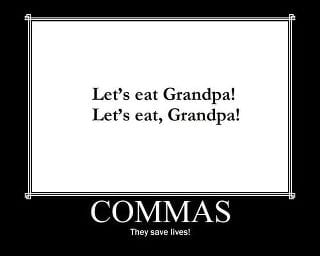
Using commas around other punctuation marks can get a little confusing. Here are a few quick tips:- Commas should always go inside quotation marks, even if the quotation ends in a period, if you are continuing your sentence.
- When Bobby said "I hate you," his mother began to cry.
- If your quotation or dialogue ends in a question mark or exclamation point, omit the comma, but continue your sentence as usual.
- When Bobby screamed "I hate you!" his mother began to cry.
- Obviously, this looks ugly. If at all possible, rearrange the sentence.
- Bobby's mother began to cry when he screamed "I hate you!"
- When you're directly addressing someone, put a comma before their name.
- Hey, Jean! How are you doing?
- What do you think, Steve?
- Look at this, Laura.
Conclusion
Well, hasn't this been fun? I hope this pair of posts has made things a little clearer. Once you understand the structure of your sentence, it's a lot easier to figure out where the commas go. (Did you notice I had a dependent/independent clause combo there?) There are a few other miscellaneous comma uses that we didn't get to. If you have any questions about them, about this post, or about our polishing service, please comment below or email us.
Wednesday, December 18, 2013
Commas, the Trickiest Punctuation Mark Ever, Part One—Lists and Setting Off
Welcome to our comma extravaganza! This is part one of a two-part series. This week, we'll be focusing on a few of the most common uses for commas and why some of the things you think you know about commas are probably wrong.
Let's start out with a few of the most common uses for commas.
Ah, the old debate. There are two ways of using commas in a list, and there are a lot of people who insist that one way is better than the other. For example, newspapers insist on one way (the latter in our previous example), and novels prefer another (the former).
Oxford comma
This is the form most advocated by publishing houses and academia. It includes a final comma before the "and," which, as its proponents argue, tends to eliminate unnecessary confusion.
The other way
Journalism tends to be about concision above all. If there's anything in there that is deemed unnecessary, a newspaper editor is going to cut it. That's why you almost never see that final comma in lists in a newspaper or online article.
Appositives might sound scary, but they're actually pretty simple. They're just a technique for renaming something. For example, in the sentence "Barack Obama, the president of the United States, will be giving an address to the nation today," we've named Obama twice. Once with his given name, once with his title. There are many ways of doing this, like "Joe's sister, Anne, hates chickpeas."
That last sentence is an example of the confusing part about appositives. Sometimes appositives imply things about the person or thing being renamed. In this case, the fact that we used "Anne" as an appositive surrounded by commas implies that Anne is Joe's only sister. Those who know Joe would already know this, but the commas signal to the rest of us that Anne is the only sister. There is no other sister, so "Anne" and "sister" are the same thing. That puts Anne in a nonrestrictive position because she wouldn't need to be named for the sentence to mean the same thing. "Joe's (only) sister (Anne) hates chickpeas."
If Joe had more than one sister, we would leave out the commas and write "Joe's sister Anne hates chickpeas." Remember, this is because appositives are equal to the thing they're naming, but if Joe has more than one sister, then Anne only partly defines "Joe's sister." She no longer qualifies for the appositive comma escort because she's not the only sister. What if the other sisters love chickpeas? It's only fair to restrict that preference to Anne, so she takes the restrictive position next to chickpeas. "Anne is Joe's sister who hates chickpeas." But seriously, who even likes chickpeas?
Parentheticals, or Asides
Commas can also be used to set off parts of sentences that are deemed "extra information" that aren't necessary to understanding the sentence. You probably learned about them as "asides."
"The Oxford comma, despite all its detractors, is flourishing in print."
What's the aside in that sentence? An easy way to tell is to take out sections and see if the sentence still makes sense. Let's try it.
There are actually a lot of ways to set aside an aside, but commas are used most often. If you wanted to, you could set off an aside with em dashes or parentheses. These techniques are especially useful if the aside has punctuation inside it already, like in this sentence: "Greg packed up his three favorite things—his teddy bear, his microscope, and his toothbrush—and headed out for an adventure."
Well, that's it for today. Next time we'll be discussing dependent, independent, and other types of clauses and what commas do for each of them. (Don't worry; we'll explain what clauses are.)
Is there something we missed that you want covered? Comment below and we'll add it to part two. Got any questions about this post or our polishing service? Feel free to comment or email us at castleeditorial@gmail.com.
Link to part two.
Misconceptions
Perhaps you have heard these guidelines of when to use a comma:"It's when you should take a breath when reading."These mantras, though popular, are incorrect. So what the heck is a comma for? Let's find out.
"It's to indicate a pause."
"A comma takes the place of 'and.'"
"Use it around someone's name."
The truth
I like to think of commas as the support structure in a sentence. Grammar and punctuation is a lot like architecture. You can't just throw together a bunch of materials and hope it comes out right; you need the proper structure in order for it to stand up properly and be what it's supposed to be.Let's start out with a few of the most common uses for commas.
Lists
Almost always, commas are used to separate elements in lists. For example, "Today I had eggs, toast, and bacon for breakfast." Wait. Or is it "Today I had eggs, toast and bacon for breakfast"?Ah, the old debate. There are two ways of using commas in a list, and there are a lot of people who insist that one way is better than the other. For example, newspapers insist on one way (the latter in our previous example), and novels prefer another (the former).
Oxford comma
This is the form most advocated by publishing houses and academia. It includes a final comma before the "and," which, as its proponents argue, tends to eliminate unnecessary confusion.
 |
| Source unknown. If you know, tell us! |
Journalism tends to be about concision above all. If there's anything in there that is deemed unnecessary, a newspaper editor is going to cut it. That's why you almost never see that final comma in lists in a newspaper or online article.
Setting off parts of your sentence
Appositives |
| Source: Quickanddirtytips.com |
Appositives might sound scary, but they're actually pretty simple. They're just a technique for renaming something. For example, in the sentence "Barack Obama, the president of the United States, will be giving an address to the nation today," we've named Obama twice. Once with his given name, once with his title. There are many ways of doing this, like "Joe's sister, Anne, hates chickpeas."
That last sentence is an example of the confusing part about appositives. Sometimes appositives imply things about the person or thing being renamed. In this case, the fact that we used "Anne" as an appositive surrounded by commas implies that Anne is Joe's only sister. Those who know Joe would already know this, but the commas signal to the rest of us that Anne is the only sister. There is no other sister, so "Anne" and "sister" are the same thing. That puts Anne in a nonrestrictive position because she wouldn't need to be named for the sentence to mean the same thing. "Joe's (only) sister (Anne) hates chickpeas."
If Joe had more than one sister, we would leave out the commas and write "Joe's sister Anne hates chickpeas." Remember, this is because appositives are equal to the thing they're naming, but if Joe has more than one sister, then Anne only partly defines "Joe's sister." She no longer qualifies for the appositive comma escort because she's not the only sister. What if the other sisters love chickpeas? It's only fair to restrict that preference to Anne, so she takes the restrictive position next to chickpeas. "Anne is Joe's sister who hates chickpeas." But seriously, who even likes chickpeas?
Parentheticals, or Asides
Commas can also be used to set off parts of sentences that are deemed "extra information" that aren't necessary to understanding the sentence. You probably learned about them as "asides."
"The Oxford comma, despite all its detractors, is flourishing in print."
What's the aside in that sentence? An easy way to tell is to take out sections and see if the sentence still makes sense. Let's try it.
- "Despite all its detractors, is flourishing in print." Well, that doesn't make sense.
- "The Oxford comma is flourishing in print." That sounds right! Let's check the last one to be sure.
- "The Oxford comma, despite all its detractors." Yep, looks like that second one is right. So that means "despite all its detractors" is the aside.
There are actually a lot of ways to set aside an aside, but commas are used most often. If you wanted to, you could set off an aside with em dashes or parentheses. These techniques are especially useful if the aside has punctuation inside it already, like in this sentence: "Greg packed up his three favorite things—his teddy bear, his microscope, and his toothbrush—and headed out for an adventure."
Well, that's it for today. Next time we'll be discussing dependent, independent, and other types of clauses and what commas do for each of them. (Don't worry; we'll explain what clauses are.)
Is there something we missed that you want covered? Comment below and we'll add it to part two. Got any questions about this post or our polishing service? Feel free to comment or email us at castleeditorial@gmail.com.
Link to part two.
Thursday, December 12, 2013
4 Contemporary Young-Adult Novels That Give YA Lit a Good Name
Young-adult literature gets a bad rap. It’s easy to see shelves of paranormal fiction stuffed with vapid female protagonists and obsessive love interests—or worse, the dreaded love triangle—all brought to dozy half-life in barely passable purpose prose, and run the opposite direction, maybe to a nice, safe biography of Abraham Lincoln. But more and more of this genre is making a name for itself, such that “young adult” describes not the quality of writing, but the age of the protagonist. YA lit published in the last few years is chock-full of big themes packaged in spellbindingly inventive plots. And, let’s face it, we’re always learning how to grow up, making these coming-of-age stories delicious literature for readers of all ages, everyone from twelve to one hundred twelve.

1. Code Name Verity, by Elizabeth Wein
It was a Michael L. Printz Honor book—the coveted prize for young adult literature—for good reason. When a British spy plane crashes in Germany during WWII, its lone passenger, a secret agent, is captured by the Gestapo. Forced to reveal her mission or face a grisly execution, the agent scribbles her intricate confession onto scraps of paper supplied by her Nazi interrogators, weaving her confession with reminisces of her past and the iron-clad friendship she developed with the pilot of the plane that crashed. Called a “fiendishly plotted mind-game of a novel,” its twists and turns will propel you to an astounding conclusion.
And if you still aren’t convinced: It breaks from YA’s tired tradition of love triangles entirely because it’s about two best friends instead of hormone-ridden puppy lovers. And a more charismatic, fallible, and honest pair of friends you could not find. If you find you adore this one as much as we did, check out its companion novel, Rose Under Fire.

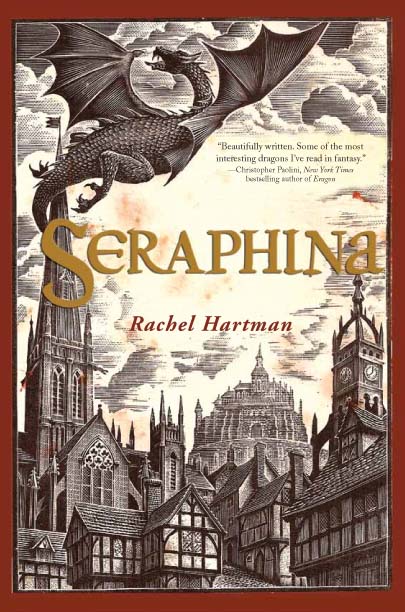
2. Seraphina, by Rachel Hartman
This is not a story of ordinary dragons. The country of Goredd is preparing to celebrate the 40-year anniversary of an uneasy peace between dragons and humans, when the Crown Prince is murdered—and all signs point to dragons at work. Seraphina Dombedgh, the court musician, is thrust into the turmoil of politics surrounding the treaty with intelligent, unemotional dragons that humans find so threatening.
And if you still aren’t convinced: Hartman’s lyric style is complemented by the music chiming through the story. Her experience with medieval culture and its music sings throughout the novel, blending an enchanting setting with bewitching melody, everything from sackbuts (the trombone’s early predecessor) to megaharmonium (a fictional instrument that’s based on a real one, the organ-like harmonium).

3. Daughter of Smoke and Bone, by Laini Taylor
The first of a trilogy, Daughter of Smoke and Bone tells the story of Karou, an enigmatic art student with an unusual day job. With a necklace of wish-granting beads and a sketchbook of fantastic monsters and demons, Karou’s story unravels with the elegance of smoke as she learns the true story of the only family she’s ever known and of the war that tore her world apart.
And if you still aren’t convinced: This kind of book will prove it—YA lit is where the epic story went. While adult literature is invested in home stories and realism, YA lit like this is where Homeric stories of gods and heroes. A lovely and ambitious, if not perfectly executed, tale of angels and demons.

4. The Fault in Our Stars, by John Green
It’s not been 44 weeks on the New York Times bestseller list for nothing. Hazel Lancaster and Augustus Waters are two normal Indianapolis teenagers—oh, except they met at a Cancer Kid Support Group. Hazel is ultimately terminal, though experimental treatment has delayed her inevitable end for a while. But when she meets Gus, her ending suddenly seems much less certain. Theirs is a love unlikely and unmatched.
And if you still aren’t convinced: Wary of reading another book about cancer kids? Fear not. This is the funniest book about cancer we’ve ever read. Which is not to say that it’s insensitive and inhumane. Its irreverent, laugh-out-loud humor belies its warm heart and serious contemplation of fate, death, and fates worth than death.

1. Code Name Verity, by Elizabeth Wein
It was a Michael L. Printz Honor book—the coveted prize for young adult literature—for good reason. When a British spy plane crashes in Germany during WWII, its lone passenger, a secret agent, is captured by the Gestapo. Forced to reveal her mission or face a grisly execution, the agent scribbles her intricate confession onto scraps of paper supplied by her Nazi interrogators, weaving her confession with reminisces of her past and the iron-clad friendship she developed with the pilot of the plane that crashed. Called a “fiendishly plotted mind-game of a novel,” its twists and turns will propel you to an astounding conclusion.
And if you still aren’t convinced: It breaks from YA’s tired tradition of love triangles entirely because it’s about two best friends instead of hormone-ridden puppy lovers. And a more charismatic, fallible, and honest pair of friends you could not find. If you find you adore this one as much as we did, check out its companion novel, Rose Under Fire.
2. Seraphina, by Rachel Hartman
This is not a story of ordinary dragons. The country of Goredd is preparing to celebrate the 40-year anniversary of an uneasy peace between dragons and humans, when the Crown Prince is murdered—and all signs point to dragons at work. Seraphina Dombedgh, the court musician, is thrust into the turmoil of politics surrounding the treaty with intelligent, unemotional dragons that humans find so threatening.
And if you still aren’t convinced: Hartman’s lyric style is complemented by the music chiming through the story. Her experience with medieval culture and its music sings throughout the novel, blending an enchanting setting with bewitching melody, everything from sackbuts (the trombone’s early predecessor) to megaharmonium (a fictional instrument that’s based on a real one, the organ-like harmonium).

3. Daughter of Smoke and Bone, by Laini Taylor
The first of a trilogy, Daughter of Smoke and Bone tells the story of Karou, an enigmatic art student with an unusual day job. With a necklace of wish-granting beads and a sketchbook of fantastic monsters and demons, Karou’s story unravels with the elegance of smoke as she learns the true story of the only family she’s ever known and of the war that tore her world apart.
And if you still aren’t convinced: This kind of book will prove it—YA lit is where the epic story went. While adult literature is invested in home stories and realism, YA lit like this is where Homeric stories of gods and heroes. A lovely and ambitious, if not perfectly executed, tale of angels and demons.

4. The Fault in Our Stars, by John Green
It’s not been 44 weeks on the New York Times bestseller list for nothing. Hazel Lancaster and Augustus Waters are two normal Indianapolis teenagers—oh, except they met at a Cancer Kid Support Group. Hazel is ultimately terminal, though experimental treatment has delayed her inevitable end for a while. But when she meets Gus, her ending suddenly seems much less certain. Theirs is a love unlikely and unmatched.
And if you still aren’t convinced: Wary of reading another book about cancer kids? Fear not. This is the funniest book about cancer we’ve ever read. Which is not to say that it’s insensitive and inhumane. Its irreverent, laugh-out-loud humor belies its warm heart and serious contemplation of fate, death, and fates worth than death.
Friday, December 6, 2013
NaNoWriMo: It's Over. Now What?
National Novel Writing Month has come and gone. So, all you NaNo-ers, how did it go? Did you meet your goals? Honestly, I fell short at the end there. I thought NaNo would be so easy, with my very attainable 2,000-words-a-day goal! But it ended up being much harder than I expected. When I went to bed on November 30th, I had a dream that I wrote my brains out and found myself miraculously at 52,000 words! I felt so accomplished . . . until I woke up. But there's no need to feel bad if you didn't finish. Whether you wrote 50,000 or 2,000 words, you should feel great! You finally got going on your novel. Now you either need to start revising or, like me, finish writing the rest of it.
After you've saved your previous work, you are ready to start revising. One way to do this is to just read the story. Fix any typos you come across immediately. For bigger things you want to change or fix, highlight the text, bold it, and insert a query to yourself. You may even want to make a master list of all the changes you want to make. If you are inspired to include a new scene or chapter, add that to the list. Once you've gotten through the entirety of the manuscript, go through your master list and begin making the changes. Go through the manuscript a couple of times in this fashion, making notes to yourself and adding or subtracting different elements. It may also help to read the text aloud.
Once you feel like your revisions are where you want them to be, take your manuscript to a reader. This can be your writing buddy, your writing group, or even your sister-in-law who loves to read. Ask them to make comments and suggestions as they read. Their comments can be invaluable in the revision process. You may be too close to the manuscript to see errors like, "Wait, I thought Carly had brown hair," or "Is there a word missing here? The sentence is confusing." So the fresh eyes of your reader(s) can help find these problems.
Revisions can take some time, so try not to get frustrated. If you do, take a break from the manuscript and let it sit for a day or two. But remember, you're almost ready to submit your manuscript for publication, so don't give up!
Have a great year. Keep writing—don't stop—and I'll see you next November when we take on NaNoWriMo all over again!
Farewell, fellow NaNo-ers!
Holly
Current Word Count: (sigh) 32,685
What's Next?
Yes, NaNo is over, but your writing isn't confined to one autumn month a year. And your book still has a ways to go, regardless of how many words you were able to type. So what is the next step in the process?Make a Goal and Keep Writing
If you weren't able to finish your novel, never fear! Now's the time to set a new goal. Perhaps you didn't hit the fifty thousand you were shooting for. Can you get there by the end of the year? Can you get there by mid January? Maybe you did hit the 50K, but the story isn't over. Can you estimate how much is left to be written? If you can't, that's okay. Instead of making a word-count goal, make a goal for how much time you'll spend writing during the week. It could be a daily goal of three hours or a weekly goal of five. Whatever your goal is, try to make it attainable as well as useful. A weekly goal of one hour isn't going to be that helpful, but it is better than not writing anything at all. |
| photo credit here |
Revise, Revise, Revise
If you were able to finish your novel, that's great! I suggest taking a day or two to relax and let the text just sit. The next step in publishing your novel is not to send it off to a publisher right away (as editor Lisa Mangum mentioned in our recent interview). You've been writing as much and as quickly as possible, so there are bound to be a few typos, errors, plot-holes, or even missing scenes. Now is the time to go back through your novel and figure out where the problems are. First, save a new copy of your manuscript. Title it something like, "Book Revision 1." That way, if you delete an entire chapter one day during revisions and then decide you want it back on another day, you still have an original file with everything you once wrote.After you've saved your previous work, you are ready to start revising. One way to do this is to just read the story. Fix any typos you come across immediately. For bigger things you want to change or fix, highlight the text, bold it, and insert a query to yourself. You may even want to make a master list of all the changes you want to make. If you are inspired to include a new scene or chapter, add that to the list. Once you've gotten through the entirety of the manuscript, go through your master list and begin making the changes. Go through the manuscript a couple of times in this fashion, making notes to yourself and adding or subtracting different elements. It may also help to read the text aloud.
Once you feel like your revisions are where you want them to be, take your manuscript to a reader. This can be your writing buddy, your writing group, or even your sister-in-law who loves to read. Ask them to make comments and suggestions as they read. Their comments can be invaluable in the revision process. You may be too close to the manuscript to see errors like, "Wait, I thought Carly had brown hair," or "Is there a word missing here? The sentence is confusing." So the fresh eyes of your reader(s) can help find these problems.
Revisions can take some time, so try not to get frustrated. If you do, take a break from the manuscript and let it sit for a day or two. But remember, you're almost ready to submit your manuscript for publication, so don't give up!
 |
| photo credit here |
Until Next NaNo . . .
I still have quite a ways to go with my NaNo novel, but it was such a blast to give the whole "write a book in a month" thing a shot. I hope all of you had as much fun as I did! Feel free to return to these NaNo posts if you ever find yourself stuck in a writing rut. And hey, if you're missing NaNo, here's one last suggestion that my writing buddy, Katherine, and I came up with: Make your own mini NaNoWriMo. Call it My Novel Writing Week (MyNoWriWee? MyNo for short!), and make a word goal. Can you write 10K this MyNo? Or maybe *gulp* 25K? You can do it!Have a great year. Keep writing—don't stop—and I'll see you next November when we take on NaNoWriMo all over again!
Farewell, fellow NaNo-ers!
Holly
Current Word Count: (sigh) 32,685
Friday, November 29, 2013
NaNo Day 29: Write-A-Thons
It's the end of NaNoWriMo! Are you putting the last few thousand words together this weekend and making it to that beautiful 50,000? I hope so! And hopefully I'll be right there with you. But if you feel like you are crazy behind in your word count (like I happen to be, yet again), then you can do what I did last week and have a write-a-thon.
Of course, things happen. And you, like me, may find yourself off the high of being on track and back to thousands of words behind (think 17,500). If you're losing hope, you can join me tomorrow, Saturday, for a NaNo write-a-thon! You'll be writing with thousands of others because, well, it's Saturday, and it also happens to be the last day of NaNo. So if you really want to finish, you may have to spend some solid hours at the keyboard, pounding out all the words you need. Just don't give up. That's the key. Start early, take some breaks, don't give up, and try not to fall asleep!
You can make it! This is coming from a girl who is seriously far behind. But I can do it too! Use all of the tips you can think of and just finish that manuscript. Maybe by the end of the day tomorrow, we'll be NaNo winners after all.
Good luck!
Holly
Current Word Count: 32,685
Write-A-Thons
A write-a-thon is just like those read-a-thons you had in fourth grade. You can load up on healthy snacks, grab a comfy pillow, and spend the day writing away. Last week, I was very behind in my writing. We're talking about ten thousand-ish words behind. I called my writing buddy (you all remember Katherine, right?), and she popped over for a few solid hours of writing. We wrote and wrote and blasted past those difficult blocks. Then, sadly, she had to go home. But did I sulk in the corner and watch Netflix for the rest of the night? NO! I kept writing. And writing. And writing! And the next day, guess what I did? I wrote some more! And by the end of that day, I was completely caught up in my word count and feeling great about life.Of course, things happen. And you, like me, may find yourself off the high of being on track and back to thousands of words behind (think 17,500). If you're losing hope, you can join me tomorrow, Saturday, for a NaNo write-a-thon! You'll be writing with thousands of others because, well, it's Saturday, and it also happens to be the last day of NaNo. So if you really want to finish, you may have to spend some solid hours at the keyboard, pounding out all the words you need. Just don't give up. That's the key. Start early, take some breaks, don't give up, and try not to fall asleep!
 |
| photo credit here |
Good luck!
Holly
Current Word Count: 32,685
Tuesday, November 19, 2013
Interview with a Publisher
We're taking a break from our NaNo posts to think about the future of those NaNo manuscripts. Have you ever wanted to get the inside scoop on how to get your manuscript noticed? Recently, we were privileged to interview author, editor, publishing veteran, and Disney enthusiast Lisa Mangum about her publishing insights. Read our interview with her below.
What do you look for in a cover letter that pushes you to read the manuscript attached?
I like a cover letter that is well-written and professional. The best cover letters have a solid hook for the manuscript that is specific and engaging and that touches on the four main elements of the story: the protagonist, the main goal, the main obstacle, and the consequence of failure. (For example: Frodo must journey to Mount Doom, battling an army of evil creatures, in order to destroy the Ring of Power, or else all of Middle Earth will fall into shadow.)
What kind of information do you like to see in the short author bio?
When it comes to author bios, tell me the important details about yourself that relate to writing. I’m interested in if you’ve been published before, if you belong to any writer’s groups or attend any writer’s conferences, or if you have won any awards or honors for your work. For first-time writers, that can be tricky since you may not have a long writing resume to share. In that case, less is more; use the space you would have used on your bio to tell me more about your book.
In the first page or so, what are the first clues or triggers in a manuscript that make you know you won’t read more? And which elements do you recognize that make you want to read more?
How can authors get their manuscript to the top of the slush pile? How can they set their book apart from other submissions?
Easy—write the best book ever written. :) Seriously, though, often I’ll pay special attention to manuscripts that come in from authors who are active in the writing community, who have attended writer’s conferences, or who have clearly paid attention to the submission guidelines and who have done their homework. Your submission is essentially your job application. You want a publisher to hire you to write stories, and your submission is proof that you would be a good investment. You wouldn’t apply for a job with a company that you didn’t know anything about, so don’t submit your manuscript without doing some homework about the company beforehand.
What are some vital things you feel a manuscript needs before you’ll consider publishing it?
I love to find a great story told with a fresh voice and built on a solid foundation of excellent writing.
What advice would you give NaNoWriMo writers who want to submit their work for publication?
Wait! NaNo is a wonderful way to get words down on paper, but any time you write that many words that quickly, you’ll want to make sure you go back through it and revise it and polish it before you submit it. So enjoy NaNo. Write all the words you have. And then wait a few months to let it settle, then spend a few more months editing and revising. Wait another month just to be sure. Then submit it. It’ll be a better book when you do.
What's the most important thing a writer can do with their manuscript before submitting it?
I don’t know if this is the most important thing, but one thing I like to do is read the manuscript out loud. That will help slow you down and see what is actually on the page and not what you think is on the page. It will help you catch typos, missing words, and spots where the writing is awkward or uneven. And if you are brave enough to read it out loud to someone else, you’ll be able to gauge if you’ve hit the emotional notes you were aiming for. Did they laugh in the right places? Cry? Beg you to read just one more chapter? If not, then you know where to go back for another look at revisions.
Do you like it when authors attach photos of themselves?
Author photos are unnecessary at the submission stage. I’m sure you look very nice, but I’m way more interested in what you’ve written and the kind of story you can tell than in how you look.
Can you tell us a bit about the manuscript acceptance and rejection processes and about how long it usually takes to hear back?
At Deseret Book/Shadow Mountain, the process is essentially the same. An author may submit his or her work online at submissions.deseretbook.com or submissions.shadowmountain.com. Then it undergoes our review process, in which we look at every single submission that comes in and evaluate the overall idea and the strength of the writing. We look at our current publishing plans and see what kinds of manuscripts we need (or which genres are oversaturated). Manuscripts that show promise are passed around the review committee for additional feedback. When we find one we would like to publish, we contact the author and begin the next phase of the process: contracts and scheduling. If, unfortunately, we decide to pass on a manuscript, we email the author with that decision as well. Our review process takes anywhere between eight to twelve weeks.
What steps should authors take upon receiving a rejection, if any?
Rejection hurts, no doubt about it, so I think it’s okay to feel sad when you receive a rejection letter from a publisher—but only for a short time. After that, you need to move forward and submit your work elsewhere. There are a lot of publishers out there, and a lot of options for authors, and the best way to turn a rejection letter into an acceptance letter is to continue to practice your craft, improve your skills, submit your work, and never let a rejection be the end of your career.
The editors at Castle Editorial know how much you want your manuscript to shine before you submit it to publishers. We want to help you get your submission noticed by any acquisitions editor as well as help free your manuscript from those tangles that prevent a publisher from picking your book. Those subtle issues, as Lisa mentioned, include "too many grammatical or spelling errors, if the writing voice is flat, if the characters are two-dimensional, if there is too much info-dumping or unnecessary description." When we get a chance to point those elements out to you with our guaranteed two sets of experienced eyes, we help your polished manuscript rise to the top! If you have any questions, leave a comment below. We can't wait to read your work!
Many thanks to Lisa for all of her great tips and information! Her wisdom and experience never cease to amaze.

Lisa Mangum has worked in the publishing department of Deseret Book since 1997 and is currently the Acquisitions Editor and Product Development Assistant. She specializes in editing fiction for the Shadow Mountain imprint and has worked with several New York Times best-selling authors, including Ally Condie, James Dashner, and Jason F. Wright. While fiction is her first love, she also has experience working with nonfiction projects (memoir, educational, cookbooks, etc.) and some children’s picture books.
She loves finding that “diamond in the rough” in the slush pile, and she is particularly skilled in the developmental editing part of the process. Lisa is also the author of four national best-selling YA novels (The Hourglass Door trilogy and After Hello). She graduated with honors from the University of Utah and currently lives in Taylorsville, Utah, with her husband, Tracy.
What do you look for in a cover letter that pushes you to read the manuscript attached?
I like a cover letter that is well-written and professional. The best cover letters have a solid hook for the manuscript that is specific and engaging and that touches on the four main elements of the story: the protagonist, the main goal, the main obstacle, and the consequence of failure. (For example: Frodo must journey to Mount Doom, battling an army of evil creatures, in order to destroy the Ring of Power, or else all of Middle Earth will fall into shadow.)
What kind of information do you like to see in the short author bio?
When it comes to author bios, tell me the important details about yourself that relate to writing. I’m interested in if you’ve been published before, if you belong to any writer’s groups or attend any writer’s conferences, or if you have won any awards or honors for your work. For first-time writers, that can be tricky since you may not have a long writing resume to share. In that case, less is more; use the space you would have used on your bio to tell me more about your book.
In the first page or so, what are the first clues or triggers in a manuscript that make you know you won’t read more? And which elements do you recognize that make you want to read more?
The first page is so important when it comes to reviewing a manuscript, and yet the main job of the first page is to make me want to read page two. I think it’s important to present a problem on that very first page—it doesn’t have to be a big problem, but if there is something amiss right out of the gate, I’m more likely to continue reading. It’s also great if you can show your hero doing something heroic in the first couple of pages. Again, it doesn’t have to be him saving the world, but a small act of kindness, or a clever quip to showcase his sense of humor, or a moment of bravery can go a long way in establishing a character and making me want to read more about him. I’ll often stop reading early in a manuscript if there are too many grammatical or spelling errors, if the writing voice is flat, if the characters are two-dimensional, if there is too much info-dumping or unnecessary description.
How can authors get their manuscript to the top of the slush pile? How can they set their book apart from other submissions?
Easy—write the best book ever written. :) Seriously, though, often I’ll pay special attention to manuscripts that come in from authors who are active in the writing community, who have attended writer’s conferences, or who have clearly paid attention to the submission guidelines and who have done their homework. Your submission is essentially your job application. You want a publisher to hire you to write stories, and your submission is proof that you would be a good investment. You wouldn’t apply for a job with a company that you didn’t know anything about, so don’t submit your manuscript without doing some homework about the company beforehand.
What are some vital things you feel a manuscript needs before you’ll consider publishing it?
I love to find a great story told with a fresh voice and built on a solid foundation of excellent writing.
What advice would you give NaNoWriMo writers who want to submit their work for publication?
Wait! NaNo is a wonderful way to get words down on paper, but any time you write that many words that quickly, you’ll want to make sure you go back through it and revise it and polish it before you submit it. So enjoy NaNo. Write all the words you have. And then wait a few months to let it settle, then spend a few more months editing and revising. Wait another month just to be sure. Then submit it. It’ll be a better book when you do.
What's the most important thing a writer can do with their manuscript before submitting it?
I don’t know if this is the most important thing, but one thing I like to do is read the manuscript out loud. That will help slow you down and see what is actually on the page and not what you think is on the page. It will help you catch typos, missing words, and spots where the writing is awkward or uneven. And if you are brave enough to read it out loud to someone else, you’ll be able to gauge if you’ve hit the emotional notes you were aiming for. Did they laugh in the right places? Cry? Beg you to read just one more chapter? If not, then you know where to go back for another look at revisions.
Do you like it when authors attach photos of themselves?
Author photos are unnecessary at the submission stage. I’m sure you look very nice, but I’m way more interested in what you’ve written and the kind of story you can tell than in how you look.
Can you tell us a bit about the manuscript acceptance and rejection processes and about how long it usually takes to hear back?
At Deseret Book/Shadow Mountain, the process is essentially the same. An author may submit his or her work online at submissions.deseretbook.com or submissions.shadowmountain.com. Then it undergoes our review process, in which we look at every single submission that comes in and evaluate the overall idea and the strength of the writing. We look at our current publishing plans and see what kinds of manuscripts we need (or which genres are oversaturated). Manuscripts that show promise are passed around the review committee for additional feedback. When we find one we would like to publish, we contact the author and begin the next phase of the process: contracts and scheduling. If, unfortunately, we decide to pass on a manuscript, we email the author with that decision as well. Our review process takes anywhere between eight to twelve weeks.
What steps should authors take upon receiving a rejection, if any?
Rejection hurts, no doubt about it, so I think it’s okay to feel sad when you receive a rejection letter from a publisher—but only for a short time. After that, you need to move forward and submit your work elsewhere. There are a lot of publishers out there, and a lot of options for authors, and the best way to turn a rejection letter into an acceptance letter is to continue to practice your craft, improve your skills, submit your work, and never let a rejection be the end of your career.
~
The editors at Castle Editorial know how much you want your manuscript to shine before you submit it to publishers. We want to help you get your submission noticed by any acquisitions editor as well as help free your manuscript from those tangles that prevent a publisher from picking your book. Those subtle issues, as Lisa mentioned, include "too many grammatical or spelling errors, if the writing voice is flat, if the characters are two-dimensional, if there is too much info-dumping or unnecessary description." When we get a chance to point those elements out to you with our guaranteed two sets of experienced eyes, we help your polished manuscript rise to the top! If you have any questions, leave a comment below. We can't wait to read your work!
Many thanks to Lisa for all of her great tips and information! Her wisdom and experience never cease to amaze.

Lisa Mangum has worked in the publishing department of Deseret Book since 1997 and is currently the Acquisitions Editor and Product Development Assistant. She specializes in editing fiction for the Shadow Mountain imprint and has worked with several New York Times best-selling authors, including Ally Condie, James Dashner, and Jason F. Wright. While fiction is her first love, she also has experience working with nonfiction projects (memoir, educational, cookbooks, etc.) and some children’s picture books.
She loves finding that “diamond in the rough” in the slush pile, and she is particularly skilled in the developmental editing part of the process. Lisa is also the author of four national best-selling YA novels (The Hourglass Door trilogy and After Hello). She graduated with honors from the University of Utah and currently lives in Taylorsville, Utah, with her husband, Tracy.
Friday, November 15, 2013
NaNo Day 15: Writing Buddies
Hello fellow NaNo writers! Another Friday is upon us, and guess what? It's day 15! You know what that means? The month is halfway over. Can you believe it? Do you have 25,000 words? I know I don't. Man, this whole NaNo thing is way harder than I thought!
Anyway, remember my last post when I talked about eating an elephant? About writing 500 words and then doing something else (like laundry)? Well, let me just say, that toooootally saved my word count that day! And I've never done so much laundry in my life!
The problem was that I did that for a total of one day. And here I am, back to thousands of words behind schedule. A few days ago, I was really upset about my lack of words. Yes, upset enough that I cried (though I blame that slightly on the pregnancy hormones). After my dear husband comforted me and then went off to work, I did the only thing I could think of to help me get over this block: I sent a whiny text to my writing buddy.
Once the manuscript is finished and we start going through revisions, that's when she pulls out the red pen and starts going after the flaws. The point is that we both know there are flaws (it's a first draft, people!), so why focus on them when there is still story to be written?
If you are feeling like you just can't do it, if you think you have the NaNo blues, then find yourself a writing buddy. Your significant other, your mom, your crazy uncle in Jamaica, anybody who you trust and who cares about you. If they push you in a positive way, then you can lean on them during the rough patches. That's what I did! And after her pep talk, I wrote over 4,000 words! So it works. I'm telling you, it does.
Happy NaNo!
Holly
Current Word Count: 21,178
Anyway, remember my last post when I talked about eating an elephant? About writing 500 words and then doing something else (like laundry)? Well, let me just say, that toooootally saved my word count that day! And I've never done so much laundry in my life!
The problem was that I did that for a total of one day. And here I am, back to thousands of words behind schedule. A few days ago, I was really upset about my lack of words. Yes, upset enough that I cried (though I blame that slightly on the pregnancy hormones). After my dear husband comforted me and then went off to work, I did the only thing I could think of to help me get over this block: I sent a whiny text to my writing buddy.
Writing Buddy
Well, she's more like my writing coach. Her name's Katherine, and she's one of my fellow Castle Editorial editors, and she is one of the best developmental editors I know. She was there while I wrote my manuscript over the summer, and she helped get me through the rough patches of that project. She does three very important things for me and my writing:1. She reads as I write.
Basically, after I write a few thousand words, I throw them all up on a Google doc for her to read when she has time. And she reads them soon after they're posted.2. She asks me for more.
Whenever I haven't posted chunks of manuscript for a few days, she asks me to send her more. If I tell her that I haven't written more, she asks me to write more for her. How can you say no to someone who asks you to write more because they want to read it?3. She never talks about the bad stuff.
She is constantly making comments about how great the story is. She'll say things like, "I love this character!" or "That description makes me so hungry," or even "This is so intense! Ahh!!" She rarely, if ever, says things like, "Your dialog seems incredibly forced," or "The setting needs some serious work." Of course, those types of comments are valid and helpful. But during a first draft, they are more inhibiting than beneficial. So instead, she says all the nice, happy things to keep me writing.Once the manuscript is finished and we start going through revisions, that's when she pulls out the red pen and starts going after the flaws. The point is that we both know there are flaws (it's a first draft, people!), so why focus on them when there is still story to be written?
If you are feeling like you just can't do it, if you think you have the NaNo blues, then find yourself a writing buddy. Your significant other, your mom, your crazy uncle in Jamaica, anybody who you trust and who cares about you. If they push you in a positive way, then you can lean on them during the rough patches. That's what I did! And after her pep talk, I wrote over 4,000 words! So it works. I'm telling you, it does.
 |
| photo credit here |
Happy NaNo!
Holly
Current Word Count: 21,178
Friday, November 8, 2013
NaNo Day 8: Losing Steam?
It's day eight of National Novel Writing Month! Are you losing steam? Well, grab some fruit snacks and a mug of cocoa and just keep on keepin' on.
Okay, so I should probably take my own advice. At the beginning of NaNo, I was totally rockin' it. My word counts were thousands of words above my goal for each day! I was feeling so accomplished. The words were flowing, the outline was moving me along perfectly, and the writing wasn't laborious.
But then life happened.
For some people, this could be having to work overtime or needing to study for a midterm or even, hopefully not, dealing with some kind of tragedy. All of these things can throw you off and make you forget that NaNo is even happening. And who could blame you? But then, there are also positive things happening in life that can distract you: a family member coming to visit for the weekend, an awesome party thrown by your roommate, or, in my case, a happy doctor's appointment followed by hours of shopping for little pink onesies. When life happens, NaNo can really just slip your mind.
And so here I am. Fifteen hundred words behind my goal word count. With dishes piled in the sink, laundry taking over the bedroom, and who-knows-what molding in the fridge. And I have no idea how to prioritize any of it. Is anybody else in this boat? I have an inkling that I'm not alone. . . .
When I was younger and would get overwhelmed with school and things, my dad would say to me, "How do you eat an elephant?" And I would sigh and mumble, "One bite at a time." I can eat today's elephant! And so can you. So here's the one-bite-at-a-time plan: 500 words. That's it! I'll write 500 words then put in a load of laundry. I'll write 500 more words then start the dishes. You probably have different tasks you need to worry about. But you can divide them with 500 words. We can do it! I mean, what's 500 words? Just a little bite of the elephant.
Good luck!
Holly
Current Word Count: 10,537
Okay, so I should probably take my own advice. At the beginning of NaNo, I was totally rockin' it. My word counts were thousands of words above my goal for each day! I was feeling so accomplished. The words were flowing, the outline was moving me along perfectly, and the writing wasn't laborious.
But then life happened.
For some people, this could be having to work overtime or needing to study for a midterm or even, hopefully not, dealing with some kind of tragedy. All of these things can throw you off and make you forget that NaNo is even happening. And who could blame you? But then, there are also positive things happening in life that can distract you: a family member coming to visit for the weekend, an awesome party thrown by your roommate, or, in my case, a happy doctor's appointment followed by hours of shopping for little pink onesies. When life happens, NaNo can really just slip your mind.
And so here I am. Fifteen hundred words behind my goal word count. With dishes piled in the sink, laundry taking over the bedroom, and who-knows-what molding in the fridge. And I have no idea how to prioritize any of it. Is anybody else in this boat? I have an inkling that I'm not alone. . . .
When I was younger and would get overwhelmed with school and things, my dad would say to me, "How do you eat an elephant?" And I would sigh and mumble, "One bite at a time." I can eat today's elephant! And so can you. So here's the one-bite-at-a-time plan: 500 words. That's it! I'll write 500 words then put in a load of laundry. I'll write 500 more words then start the dishes. You probably have different tasks you need to worry about. But you can divide them with 500 words. We can do it! I mean, what's 500 words? Just a little bite of the elephant.
Good luck!
Holly
Current Word Count: 10,537
 |
| photo credit here |
Friday, November 1, 2013
NaNo Day 1
Hello, NaNo-ers! (NaNo-ers? NaNoWriters? NaNoWri-ers?) And welcome to day one of National Novel Writing Month! The crowd erupts in applause. Hooray! How's it going? Are you feeling good about things?
What's your word count? I just hit 2,102. Starting off strong! Do you have a writing plan or schedule that you're hoping to stick to? I know I do, and I wouldn't be able to succeed without it.
Anyway, I know the day isn't even close to being over. And there's no reason to stop writing (except for the fact that I'm starving—where'd I put that Count Chocula . . .), but I figured I'd post early to help motivate those who are struggling. I exceeded my goal by 102 words! Are you on your way to hitting your goal on Day 1?
Happy NaNo!
Holly
Current Word Count: 2,102
What's your word count? I just hit 2,102. Starting off strong! Do you have a writing plan or schedule that you're hoping to stick to? I know I do, and I wouldn't be able to succeed without it.
 |
| photo credit here |
My Plan
This is how I broke down my schedule. There are 30 days in November. Of our 30 days this wonderful year of 2013, there are 4 Sundays. Personally, I don't want to write on Sunday. For some people, Sunday is their only day to write. But for me, that's my day with the hubbans. So now I'm down to 26 days. I previously decided that 2,000 words a day would be a good goal because, in my writing style, that's usually half of a chapter. So I thought, What if I wrote 2K every day for 26 days? That gets me up to 52,000, and you know what that means: wiggle room! In case I don't hit 2K every day, I have two thousand words to spare by the end. So that's my goal. That's my plan. You can make a plan, too. You can choose to go the math route, or just write your brains out every single day. For me, I needed to know what my smaller, daily goals were.Anyway, I know the day isn't even close to being over. And there's no reason to stop writing (except for the fact that I'm starving—where'd I put that Count Chocula . . .), but I figured I'd post early to help motivate those who are struggling. I exceeded my goal by 102 words! Are you on your way to hitting your goal on Day 1?
Happy NaNo!
Holly
Current Word Count: 2,102
Thursday, October 31, 2013
Happy Hallow--WAIT, NANO IS TOMORROW!!
Hey, everybody! It's Holly again. Holly stands on tiptoe and waves to the vast audience. Remember me? First, Happy Halloween! Don't forget to hoard your kids' candy tonight (I don't have kids, so I'll just turn off all the lights in my house and pretend I don't hear the doorbell. The Jolly Rancher Chews are MINE!), because you just may need it in the coming weeks.
I love Halloween. The decorations, the candy, the pumpkin-flavored everything. Yep. This is my kind of party. But in a few hours . . . the world of witches and warlocks and goblins and ghouls becomes . . . NANO! Lightning flashes in the windows and cackling catches on the wind. Don't worry, don't worry. It's all going to be okay. Don't believe me? That's okay. Let me help you convince yourself.
Hopefully these two outlining strategies will help you as you fret during the remaining hours of October. But really, don't fret, just write (after midnight, of course). It will all work out. And if you ever feel stuck, just keep writing anyway. But now's not the time to talk about getting stuck. I'm sure all of that will come later.
Happy NaNo! (Oh, and Happy Halloween!)
Holly
I love Halloween. The decorations, the candy, the pumpkin-flavored everything. Yep. This is my kind of party. But in a few hours . . . the world of witches and warlocks and goblins and ghouls becomes . . . NANO! Lightning flashes in the windows and cackling catches on the wind. Don't worry, don't worry. It's all going to be okay. Don't believe me? That's okay. Let me help you convince yourself.
Outline Time
Go on, open a word processor, grab a notepad, or steal some note cards from a nearby backpack. It's time to get down to business. Of course, as you know, we can't actually write anything for a few hours. But we can get our thoughts in order. There are a bunch of ways to outline, but I'll just tell you the two ways that worked for me.Timeline Note Cards
With my summer manuscript, I used 3x5 note cards. I wrote titles of scenes on them and put them in order. I also drew maps of locations like a house, a school, or even a bedroom. I made lists of characters that went together. I wrote "Flashback" on a few and filled them in with background info. On some of the cards, I used specific colors of ink, so that I knew what was going on. The stack of cards was my lifeline (and I almost lost it a few times). But if chapters spilled onto the page in the wrong order, that was okay with me. I just made sure to move the cards around so I didn't forget the important stuff. Scenes got lumped together, and scenes got stretched out. But overall, the note cards stayed the same. You may like this style of outlining if you like to have something physical to connect you to your manuscript. You can hold the scenes in your hands, stare at them, scribble on them, whatever you want. If that sounds appealing, you should try the note card outlining method. |
| photo credit here |
List of Thoughts
This is the kind of outline I used for my NaNo manuscript. I pulled up my word processor, and I made a bulleted list. But, well, things kind of got out of hand. At first, the list was practical. Something like,- Lisa lives in Florida.
- Lisa's mom is sick.
- Lisa's dad is in jail.
- Lisa gets a letter from her dad talking about how he's getting out in a few months.
- Lisa dives into the ocean, mere moments before the gunfire erupts behind her. She knows that Derrick will stop at nothing to capture her, so she swims with all her might. But the waves are crashing and the salt stings her eyes. Her arms flail, and soon, she's choking water into her lungs and sinking into the ocean. Suddenly, she feels fingers wrapping around her wrists! She tries to kick away, but the person holding her is much too strong. She can't open her eyes to that salt again, but she knows that she has to escape somehow. Before she has a chance to worry about drowning (or maybe she is worried about drowning), the fingers turn into arms around the trunk of her body, lifting her to the surface of the water. She coughs water out of her lungs and breathes in the sea air. Too exhausted to fight, she leans back against her rescuer and feels her hair get caught on his stubbly chin like velcro.
 |
| photo credit here |
Hopefully these two outlining strategies will help you as you fret during the remaining hours of October. But really, don't fret, just write (after midnight, of course). It will all work out. And if you ever feel stuck, just keep writing anyway. But now's not the time to talk about getting stuck. I'm sure all of that will come later.
Happy NaNo! (Oh, and Happy Halloween!)
Holly
Tuesday, October 29, 2013
Gearing up for NaNoWriMo
Hey, all you writers out there! In just a few short days, Halloween will come to an end . . . and National Novel Writing Month (also known as "November") will begin! Are you ready? Are you inspired? Are you freaking out because you don't yet have an idea? Well, never fear! We here at Castle Editorial will be with you every step of the way.
CE has four editors, and I am just one of them. Perhaps it is time to introduce myself. I'm Holly. Hello! Yes, I'm an editor. So why do I care about NaNo? Well, I'm also a writer. Okay, I don't quite feel like I can call myself a writer just yet. I've never been published. (Unless you count that haiku from third grade.) I've actually never submitted a manuscript for publication either. But have I written a full-length manuscript? YES! Just this past summer, actually. Anyway, I like to write. And I would like to be published some day. And NaNo is one way to force yourself into writing a lot and build the habit of writing all the time.
This is my very first time doing NaNo, so I'll be posting a lot about my experience. Hopefully the things I learn along the way will help you in your venture. And hey! Maybe by the end of all this, we'll all have pretty decent manuscripts to send off to agents, publishers, or our dear friends at Castle Editorial.
Good luck this month! Just 50,000 words to go!
Holly
CE has four editors, and I am just one of them. Perhaps it is time to introduce myself. I'm Holly. Hello! Yes, I'm an editor. So why do I care about NaNo? Well, I'm also a writer. Okay, I don't quite feel like I can call myself a writer just yet. I've never been published. (Unless you count that haiku from third grade.) I've actually never submitted a manuscript for publication either. But have I written a full-length manuscript? YES! Just this past summer, actually. Anyway, I like to write. And I would like to be published some day. And NaNo is one way to force yourself into writing a lot and build the habit of writing all the time.
This is my very first time doing NaNo, so I'll be posting a lot about my experience. Hopefully the things I learn along the way will help you in your venture. And hey! Maybe by the end of all this, we'll all have pretty decent manuscripts to send off to agents, publishers, or our dear friends at Castle Editorial.
Good luck this month! Just 50,000 words to go!
Holly
 |
| Photo Credit |
Thursday, October 24, 2013
How to Work with an Editor
Editors can be scary, we know. We know how attached you are to your work and how intimidating it is to let anybody read it, let alone someone who is paid to criticize it. Today's blog is all about how to help you navigate your relationship with this scary person so that your work comes out the other end nice and polished and ready to publish.
(Normally, editors at publishing houses will do a comprehensive or substantive edit of your work, so just expect that level of edit. But if you hire a freelancer, you will be able to specify what type you'd like. When you've gone through your freelancer and submit to a publishing house, expect it to go through another round of more intense edits.)
When you are ready to have your project edited, make sure you have these facts in mind and know what you want, otherwise what you expected to be a light proofread could come back with stricken paragraphs. Editors don't want to overstep their bounds, so make sure you tell them exactly what those bounds are.
That said, of course, be polite when you dispute a change. Starting your objections with "I think..." or "I feel like..." is always a good way to go. Don't accuse your editor of shredding your manuscript or ruining your work. That's a good way to get your MS back without any improvements and without a refund. Realize that your editor is trying to help you get your manuscript in the best possible position before you publish, not trying to impose their own perspective.

Many authors make the mistake of allowing their egos to get in the way of editing, and this is almost always a guarantee for a shoddy product. Be humble and allow your editor to do what they do best. Working together will turn out the best version of your work you could have hoped for!
See, now, that wasn't so scary, was it?
Know What to Ask For
When you first submit your manuscript, make sure you know exactly how much editing you want your editor to do. Didn't know there were different levels of editing? Here's a quick rundown:- Substantive editing (sometimes called structural or content editing) is the heaviest level of editing. This involves potential rewriting or restructuring on the editor's side, which is done to ensure the highest level of comprehension and consistency. Expect to see significant changes to your work.
- Copyediting aims to achieve accuracy, clarity, and consistency in a document. This may involve reworking sentences to make them more effective.
- Proofreading includes checking for grammar and missing punctuation, ensuring that elements are in the proper order, etc. You will likely not see content changes.
 |
| Hopefully your MS doesn't look like this when you get it back. But it might! Credit: http://nebuly.blogspot.com/ |
(Normally, editors at publishing houses will do a comprehensive or substantive edit of your work, so just expect that level of edit. But if you hire a freelancer, you will be able to specify what type you'd like. When you've gone through your freelancer and submit to a publishing house, expect it to go through another round of more intense edits.)
When you are ready to have your project edited, make sure you have these facts in mind and know what you want, otherwise what you expected to be a light proofread could come back with stricken paragraphs. Editors don't want to overstep their bounds, so make sure you tell them exactly what those bounds are.
Challenge Queries and Changes
Now, odds are you're going to disagree with some of the changes your editor is making. That's okay! It's your work, and we recognize that. If you think a change is not appropriate, let your editor know. He or she can explain their reasoning, and you can explain yours. This opens up a dialog that allows you to get what you need while still improving your MS. Win-win! |
| Credit: Forbes |
That said, of course, be polite when you dispute a change. Starting your objections with "I think..." or "I feel like..." is always a good way to go. Don't accuse your editor of shredding your manuscript or ruining your work. That's a good way to get your MS back without any improvements and without a refund. Realize that your editor is trying to help you get your manuscript in the best possible position before you publish, not trying to impose their own perspective.
Be Objective
On that note, sometimes it's best to trust your editor. After all, they're looking out for you and the success of your project. They also have a lot of experience working on different types of projects, and they know what needs to be done to a manuscript to really make it shine. Even though it's hard, try to let go of your feelings toward your work and see it from an outsider's perspective. You might realize that some changes you thought were too much are truly for the better.
Many authors make the mistake of allowing their egos to get in the way of editing, and this is almost always a guarantee for a shoddy product. Be humble and allow your editor to do what they do best. Working together will turn out the best version of your work you could have hoped for!
See, now, that wasn't so scary, was it?
Subscribe to:
Posts (Atom)